January 1, 2026 • Sivam Pillai • 5 minutes read
What Is It That AI Really Unlocks?
I have been pondering this question for a while now.
Every other week, headlines announce another wave of AI-driven layoffs:
- 75% of staff let go.
- 300 roles eliminated.
- Entire departments made redundant.
The optimist responds quickly: “These aren’t job losses, they are signals. New skills will be needed. New jobs will emerge. We’re simply in a transition.”
But when you ask what those new jobs actually look like, the answers often become vague.
The pessimists offer a darker view. Past technological revolutions - machines, electricity, computers - mainly replaced physical labor. Humans adapted by moving up the value chain. AI, they argue, replaces cognitive labor itself. If thinking, reasoning, and planning are automated, what’s left?
Some flip this concern into a promise of abundance: a future where people no longer need to work to earn a living. It sounds hopeful, but also abstract. It’s hard to visualize what such a society looks like - or how we transition to it without real pain.
To make sense of where AI might truly lead us, I find it useful to step back and ask a simpler question: What human limitation is AI actually removing?
From Human Limits to Intent → Outcome
Every major technology shows up when humans hit a form of exhaustion.
- Physical exhaustion led to machines and automation.
- Energy constraints led to electricity.
- Cognitive overload led to computing.
AI is arriving because we’ve hit a new limit: cognitive saturation. Yet relief alone does not guarantee progress. For AI to truly benefit individuals, nations, and the global economy, it must unlock something deeper than efficiency.
The framing I keep coming back to is this:
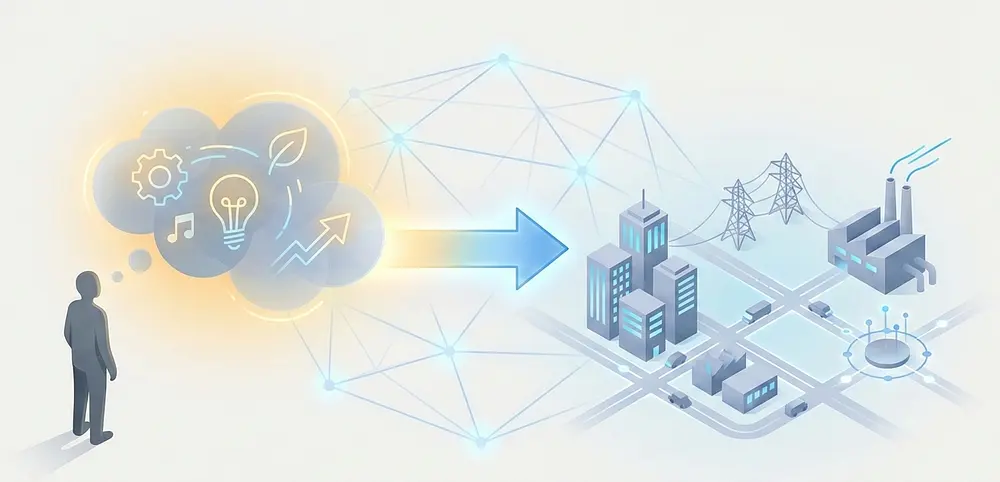
AI dramatically lowers the cost of turning human intent into sustained outcomes.
Having ideas has never been the hard part. Execution has.
Whether it’s building a business, reforming policy, optimizing energy systems, or improving health outcomes, the path from aspiration to reality has always required large teams, constant coordination, specialized tools, and ongoing supervision. Most ambitions stayed small - not because they lacked merit, but because execution costs were overwhelming.
AI changes that equation.
With agentic AI systems, we are approaching a world where a human can express an outcome - not a rigid task list, but an intent - and delegate the rest: monitoring, decision-making, execution, and correction over time.
Computers required explicit logic.
The internet required human coordination.
AI introduces delegated agency.
And that’s where something new begins.
Why This Creates Growth (Not Just Efficiency)
Growth comes from expanding what humans can afford to care about - not just doing the same work faster.Efficiency alone doesn’t create growth.
If AI only makes existing work faster or cheaper - writing code, answering tickets, generating content - we get cost compression, margin pressure, fewer jobs, and stagnant demand.
Growth happens when technology expands what humans find feasible to pursue.
AI does exactly that.
It allows us to care about, manage, and optimize things that were previously too complex, too dynamic, or too expensive to touch. This isn’t just about doing the same things better - it’s about doing entirely new things:
- Energy systems that continuously self-optimize.
- Factories that reconfigure themselves based on demand.
- Businesses that detect and correct failure before it happens.
- Personal finances and health plans that evolve over time.
Humans never demanded these systems - not because we didn’t want them, but because they were impossible to run manually.
AI expands demand through feasibility. When something becomes feasible, it becomes desirable.
Trust, Jobs, and the Shape of What Comes Next
Of course, AI comes with a foundational challenge: it’s probabilistic, not deterministic. The same input can produce different outputs. Some will be wrong.
But the solution isn’t perfection. Humans themselves are probabilistic.
The emerging design pattern is clear: a deterministic shell around a probabilistic core. Constraints, validation loops, redundancy, escalation paths, and outcome-based evaluation. We don’t make AI perfect - we make it self-correcting.
This alone creates entire categories of work.
On one side, builders of agency: people designing and managing AI systems - architects, workflow designers, evaluation and reliability engineers, infrastructure and data builders.
On the other, builders of outcomes: entrepreneurs, creators, scientists, and domain experts who use AI to turn lived experience into scalable value. AI collapses the minimum viable team size. A student can build a company. A factory supervisor can orchestrate self-configuring machines. An artist or educator can create deeply personalized experiences.
AI collapses the minimum viable team size. Entire industries will reorganize around this reality. AI becomes the universal translator from expertise to impact.
Abundance, Responsibility, and This Moment in Time
AI doesn’t just reduce costs. It expands the surface area of what humans believe is possible.
From optimizing cities to managing planetary resources, AI allows us to pursue ambitions that once felt unrealistic. For the first time, it’s plausible to imagine a society that moves closer to abundance - not because work disappears, but because value creation becomes broadly accessible.
This future isn’t automatic.
The investment required will look unreasonable. Some will call it a bubble. History suggests we may need to invest 10× - perhaps even 100× - before the benefits fully materialize.
Skepticism is understandable. Hesitation is costly.
- As individuals, we need to learn how to specify intent clearly.
- As builders, we need to make AI reliable and trustworthy.
- As nations, we need to move fast enough to soften the transition.
If we do, we raise a generation capable of building almost anything they imagine - within a society defined more by abundance than scarcity.
That, to me, is what AI truly unlocks.
Related from the thinking lab
Other things connected by tags — essays, projects, quotes, notes, and collections.